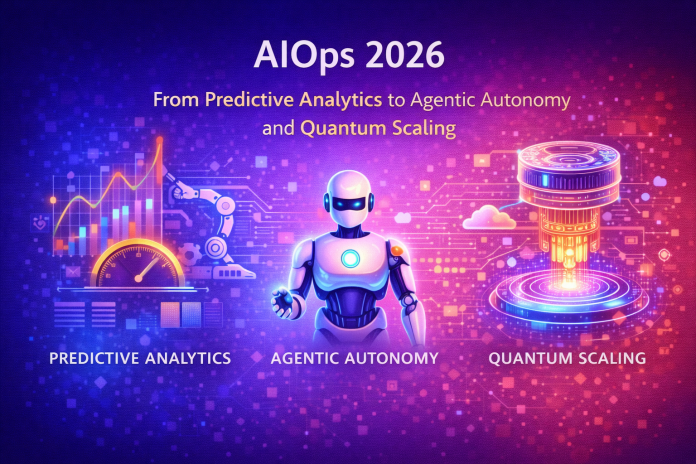
AIOps 2026: From Predictive Analytics to Agentic Autonomy and Quantum Scaling

In 2026, the “A” in AIOps no longer stands for simple “Artificial Intelligence“—it stands for Autonomy. As enterprise architectures evolve into hyper-distributed, multi-cloud meshes, the classical approach of “Dashboard and Alert” has officially failed.
The industry is now entering the era of Agentic AIOps and Post-Classical Infrastructure.
 
The most significant evolution this year is the transition from Large Language Models (LLMs) to Large Action Models (LAMs).
  • The 2024 Approach: AIOps tells you a server is down.
  • The 2026 Approach: An AI Agent detects the latency, spins up a temporary containerized instance, migrates the traffic, and submits a Jira ticket explaining the root cause and the fix it already applied.
Key Term: Self-Healing Loops. These are no longer experimental; they are the standard for Fortune 500 SRE teams.
 
Quantum-Enhanced AIOps (Q-AIOps): Solving the Exascale Problem
As of 2026, data volume has surpassed the processing capabilities of traditional silicon-based pattern matching.
  • Combinatorial Optimization: Quantum annealers, accessed via hybrid cloud platforms like AWS Braket or IBM Quantum, are now solving complex resource allocation problems—deciding how to route millions of micro-requests across 50+ global regions for maximum cost-efficiency.
  • Real-time Threat Neutralization: Quantum algorithms are the only systems capable of detecting “Polymorphic Malware” that changes its code structure every few seconds to evade classical AIOps detection.
Strategic Trends Defining the 2026 Landscape
 
1. The “GreenOps” Mandate
Sustainability is now a hard KPI for IT Ops. AIOps platforms in 2026 are integrated with real-time carbon tracking. Platforms must optimize for Energy-Aware Scheduling, moving non-critical workloads to data centers running on renewable energy at that specific hour.
 
2. Governance and “Human-in-the-Loop” (HITL)
With autonomy comes the risk of “AI Hallucinations” in infrastructure. The 2026 AIOps stack includes Explainability Layers. Before an AI agent executes a major network change, it must present a “Natural Language Proof” of why that action is safe, which is then verified by an automated policy engine.
 
3. Edge AIOps and 6G Integration
The rollout of 6G has pushed processing to the extreme edge. AIOps must now manage “Micro-Data Centers” in autonomous vehicles and smart cities, requiring low-latency, decentralized AI models that operate without a constant connection to the central cloud.
 
Preparing Your Infrastructure for 2027 and Beyond
For the AiOps Community, the roadmap is clear:
  1. Transition to OpenTelemetry (OTel): Standardized data is the only way to feed 2026’s advanced LAMs.
  2. Adopt “Causal” over “Correlative” AI: Stop looking at what happened together; start using AI that understands the dependency map of your entire business logic.
  3. Invest in Quantum Literacy: Even if you aren’t using quantum hardware yet, your AIOps software should be “Quantum-Ready”—able to integrate with Q-APIs as they become mainstream.

Author
Experienced in the entrepreneurial realm and skilled in managing a wide range of operations, I bring expertise in startup launches, sales, marketing, business growth, brand visibility enhancement, market development, and process streamlining.

Hot this week

Building an AI-Powered Log Noise Suppression Lab

A hands-on lab for building adaptive log suppression with OpenTelemetry, feature extraction, and anomaly scoring—reduce noise while preserving forensic fidelity.

Terraform Is Green, Systems Are Red: Drift in AIOps

Terraform may report success while production quietly drifts. Learn how to detect configuration, runtime, and behavioral drift using observability, policy engines, and AIOps-driven reconciliation.

Reference Architecture: End-to-End Incident AI Pipeline

A vendor-neutral blueprint of the full Incident AI pipeline—from alert ingestion to RCA, remediation, and postmortem learning—plus build-vs-buy guidance for enterprise teams.

Designing the AIOps Data Layer for Signal Fidelity

Most AIOps failures stem from weak data foundations. This deep-dive guide defines canonical pipelines, schema strategies, and quality controls to preserve signal fidelity.

Enhance AIOps Security with Advanced Threat Detection

Explore practical strategies to secure AIOps pipelines with advanced threat detection, enhancing data protection and integrity in evolving IT environments.

Topics

Building an AI-Powered Log Noise Suppression Lab

A hands-on lab for building adaptive log suppression with OpenTelemetry, feature extraction, and anomaly scoring—reduce noise while preserving forensic fidelity.

Terraform Is Green, Systems Are Red: Drift in AIOps

Terraform may report success while production quietly drifts. Learn how to detect configuration, runtime, and behavioral drift using observability, policy engines, and AIOps-driven reconciliation.

Reference Architecture: End-to-End Incident AI Pipeline

A vendor-neutral blueprint of the full Incident AI pipeline—from alert ingestion to RCA, remediation, and postmortem learning—plus build-vs-buy guidance for enterprise teams.

Designing the AIOps Data Layer for Signal Fidelity

Most AIOps failures stem from weak data foundations. This deep-dive guide defines canonical pipelines, schema strategies, and quality controls to preserve signal fidelity.

Enhance AIOps Security with Advanced Threat Detection

Explore practical strategies to secure AIOps pipelines with advanced threat detection, enhancing data protection and integrity in evolving IT environments.

Pod-Level Resource Managers and AIOps Signal Integrity

Kubernetes 1.36’s pod-level resource managers reshape more than scheduling—they redefine observability signals. Here’s how memory QoS and pod-scoped controls impact AIOps baselines, forecasting, and automation.

Comparing FinOps Tools for Cost-Efficient AIOps Management

Explore and compare leading FinOps tools to optimize AIOps costs. Evaluate features, pricing, and real-world performance for informed financial decision-making.

AI-Driven Observability: Future Trends in IT Monitoring

Explore how AI-driven observability is transforming IT operations with predictive analytics, automated analysis, and enhanced security.
spot_img

Related Articles

Popular Categories

spot_imgspot_img

Related Articles