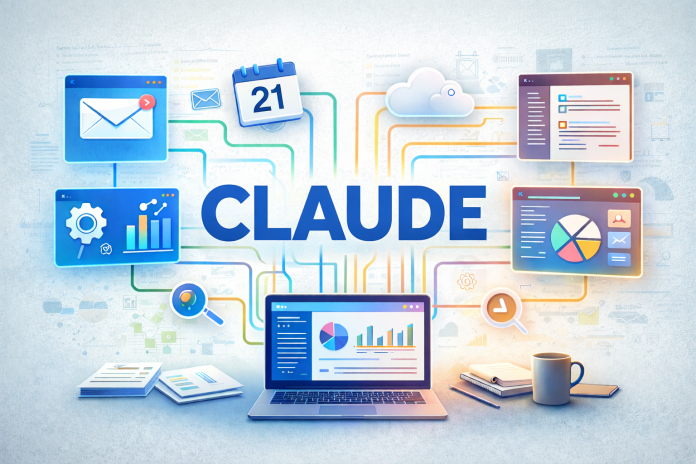

Anthropic is expanding the capabilities of its AI assistant Claude with a new plugins framework aimed at transforming how AI integrates into everyday office jobs.
The move signals Anthropic’s growing ambition to position Claude not just as a conversational AI, but as a practical workplace tool capable of interacting directly with enterprise software, documents, and business systems.
Turning AI Into a Workplace Co-Worker
With the introduction of plugins, Claude can now connect to third-party applications and internal business tools, allowing it to retrieve data, perform structured actions, and assist with multi-step tasks inside professional environments.
Rather than simply generating text responses, the AI can:
-
Access documents and databases
-
Pull real-time information from connected systems
-
Assist with workflow automation
-
Support project coordination and reporting
-
Help draft, analyze, and summarize enterprise data
This marks a shift from AI as a standalone chatbot to AI as an integrated workplace assistant.
Competing in the Enterprise AI Race
The move places Anthropic more directly in competition with other AI providers targeting enterprise productivity. As AI adoption accelerates in corporate settings, the ability to connect large language models with office software ecosystems has become a key differentiator.
By enabling plugin integrations, Anthropic is signaling that the next phase of AI growth will depend on embedded functionality, not just model performance.
Addressing Office Job Transformation
The expansion into plugins also feeds into broader discussions about AI’s impact on office work. AI systems capable of handling scheduling, documentation, reporting, and knowledge retrieval could significantly reshape administrative and knowledge-based roles.
Anthropic has positioned Claude as an assistant that augments workers rather than replaces them. By focusing on structured workflows and contextual understanding, the company aims to make AI a productivity enhancer rather than a disruption tool.
Security and Enterprise Controls
As AI becomes embedded within enterprise systems, issues such as data security, permissions, and governance become critical. Anthropic has emphasized that enterprise-grade safeguards and controlled integrations are central to its plugin strategy.
Organizations adopting AI tools increasingly demand transparency, compliance, and oversight mechanisms—especially when sensitive business information is involved.
The Future of AI in Office Environments
The introduction of plugins reflects a broader shift in the AI industry: language models are evolving from passive responders into active digital collaborators capable of executing real tasks across software platforms.
For enterprises, the real value of AI will likely come from how seamlessly it integrates into existing workflows. Anthropic’s move suggests that the competition is no longer just about model size or accuracy—but about practical workplace utility.
Looking Ahead
As companies explore AI-driven productivity gains, tools like Claude with plugin capabilities could become central to digital transformation strategies. The next phase of AI adoption in office environments will depend on balancing efficiency, trust, and responsible deployment.
Anthropic’s expansion into plugins marks another step toward AI systems that operate not only as conversational partners, but as embedded contributors to modern business operations.