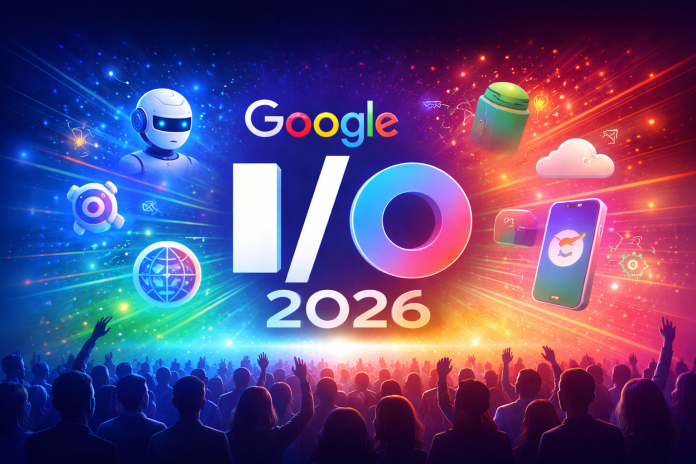
Google Announces Dates for I/O 2026, Its Biggest Annual Developer Event

Google has officially announced the dates for Google I/O 2026, its flagship annual developer conference that showcases the company’s latest advancements in artificial intelligence, software platforms, and emerging technologies.

The event, widely regarded as one of the most important gatherings in the global tech calendar, is expected to highlight Google’s evolving AI strategy, updates to Android, and new developments across its cloud and developer ecosystems.


A Major Platform for AI and Innovation

Google I/O has increasingly become a stage for unveiling major AI initiatives. In recent years, the company has used the conference to introduce updates to generative AI models, AI-powered search enhancements, and new developer tools designed to integrate AI into applications at scale.

With AI now central to Google’s long-term strategy, I/O 2026 is expected to focus heavily on:

  • Next-generation AI models and capabilities

  • AI integration across consumer products

  • Developer tools powered by machine learning

  • Advances in cloud-based AI services

The conference typically features keynote presentations, technical sessions, product demonstrations, and hands-on workshops for developers.


Android and Platform Updates

Beyond AI, Google I/O traditionally includes major updates to Android, along with improvements to web technologies, Chrome, and cross-platform development tools. Developers often look to the event for insights into new APIs, platform features, and performance enhancements.

The 2026 edition is expected to continue this tradition, offering guidance for developers building apps across smartphones, wearables, and connected devices.


Developer and Global Community Engagement

Google I/O attracts thousands of developers, engineers, and technology enthusiasts both in person and through live-streamed sessions. The event serves as a hub for community engagement, enabling developers to interact directly with Google’s product teams.

Workshops and technical deep dives are likely to provide practical insights into implementing AI features, optimizing applications, and leveraging Google Cloud services.


Strengthening Google’s AI-First Vision

As competition intensifies in the AI space, Google I/O 2026 will likely reinforce the company’s AI-first vision. With AI shaping everything from search and advertising to productivity tools and cloud infrastructure, the conference is expected to offer a clearer roadmap for how Google plans to lead in the next phase of AI innovation.


Looking Ahead

With anticipation already building, Google I/O 2026 promises to deliver major announcements that could influence the direction of AI, mobile platforms, and cloud computing over the coming year.

For developers and technology leaders alike, the event remains a key opportunity to understand how Google’s evolving technologies will shape the broader digital ecosystem.


Author
Experienced in the entrepreneurial realm and skilled in managing a wide range of operations, I bring expertise in startup launches, sales, marketing, business growth, brand visibility enhancement, market development, and process streamlining.

Hot this week

Building an AI-Powered Log Noise Suppression Lab

A hands-on lab for building adaptive log suppression with OpenTelemetry, feature extraction, and anomaly scoring—reduce noise while preserving forensic fidelity.

Terraform Is Green, Systems Are Red: Drift in AIOps

Terraform may report success while production quietly drifts. Learn how to detect configuration, runtime, and behavioral drift using observability, policy engines, and AIOps-driven reconciliation.

Reference Architecture: End-to-End Incident AI Pipeline

A vendor-neutral blueprint of the full Incident AI pipeline—from alert ingestion to RCA, remediation, and postmortem learning—plus build-vs-buy guidance for enterprise teams.

Designing the AIOps Data Layer for Signal Fidelity

Most AIOps failures stem from weak data foundations. This deep-dive guide defines canonical pipelines, schema strategies, and quality controls to preserve signal fidelity.

Enhance AIOps Security with Advanced Threat Detection

Explore practical strategies to secure AIOps pipelines with advanced threat detection, enhancing data protection and integrity in evolving IT environments.

Topics

Building an AI-Powered Log Noise Suppression Lab

A hands-on lab for building adaptive log suppression with OpenTelemetry, feature extraction, and anomaly scoring—reduce noise while preserving forensic fidelity.

Terraform Is Green, Systems Are Red: Drift in AIOps

Terraform may report success while production quietly drifts. Learn how to detect configuration, runtime, and behavioral drift using observability, policy engines, and AIOps-driven reconciliation.

Reference Architecture: End-to-End Incident AI Pipeline

A vendor-neutral blueprint of the full Incident AI pipeline—from alert ingestion to RCA, remediation, and postmortem learning—plus build-vs-buy guidance for enterprise teams.

Designing the AIOps Data Layer for Signal Fidelity

Most AIOps failures stem from weak data foundations. This deep-dive guide defines canonical pipelines, schema strategies, and quality controls to preserve signal fidelity.

Enhance AIOps Security with Advanced Threat Detection

Explore practical strategies to secure AIOps pipelines with advanced threat detection, enhancing data protection and integrity in evolving IT environments.

Pod-Level Resource Managers and AIOps Signal Integrity

Kubernetes 1.36’s pod-level resource managers reshape more than scheduling—they redefine observability signals. Here’s how memory QoS and pod-scoped controls impact AIOps baselines, forecasting, and automation.

Comparing FinOps Tools for Cost-Efficient AIOps Management

Explore and compare leading FinOps tools to optimize AIOps costs. Evaluate features, pricing, and real-world performance for informed financial decision-making.

AI-Driven Observability: Future Trends in IT Monitoring

Explore how AI-driven observability is transforming IT operations with predictive analytics, automated analysis, and enhanced security.
spot_img

Related Articles

Popular Categories

spot_imgspot_img

Related Articles