Google Launches AI-Powered Shopping Tool for Major Online Retailers

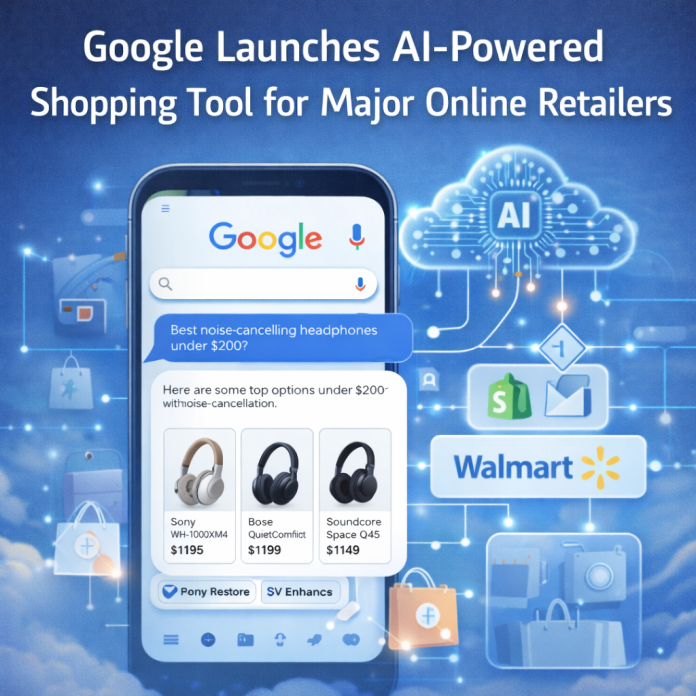
Google has introduced a new AI-powered shopping tool designed to help users discover and compare products directly within its ecosystem. The tool is being rolled out for major retailers and platforms, including Shopify-based stores, Walmart, and other merchants, allowing shoppers to get product suggestions, comparisons, and insights using conversational AI.

The feature enables users to ask natural language questions about products—such as pricing, availability, features, and alternatives—and receive AI-generated responses based on information from participating retailers. This approach is intended to simplify online shopping by reducing the need to browse multiple websites manually.

The launch comes at a time when AI-driven shopping assistants are gaining traction across the tech industry. Google’s tool closely resembles similar AI shopping experiences being tested elsewhere, where conversational systems guide users through purchase decisions by summarizing product data and highlighting key differences.

At the same time, the growing use of AI in shopping has raised concerns around data usage, content ownership, and fair competition. Some companies have expressed legal and ethical concerns about how AI systems source and present product information, especially when it closely mirrors existing commercial platforms.

With this move, Google is positioning itself as a stronger player in AI-assisted commerce, aiming to reshape how users search for and buy products online while competing more directly with established e-commerce and AI platforms.


Author
Experienced in the entrepreneurial realm and skilled in managing a wide range of operations, I bring expertise in startup launches, sales, marketing, business growth, brand visibility enhancement, market development, and process streamlining.

Hot this week

Terraform Is Green, Systems Are Red: Drift in AIOps

Terraform may report success while production quietly drifts. Learn how to detect configuration, runtime, and behavioral drift using observability, policy engines, and AIOps-driven reconciliation.

Reference Architecture: End-to-End Incident AI Pipeline

A vendor-neutral blueprint of the full Incident AI pipeline—from alert ingestion to RCA, remediation, and postmortem learning—plus build-vs-buy guidance for enterprise teams.

Designing the AIOps Data Layer for Signal Fidelity

Most AIOps failures stem from weak data foundations. This deep-dive guide defines canonical pipelines, schema strategies, and quality controls to preserve signal fidelity.

Enhance AIOps Security with Advanced Threat Detection

Explore practical strategies to secure AIOps pipelines with advanced threat detection, enhancing data protection and integrity in evolving IT environments.

Pod-Level Resource Managers and AIOps Signal Integrity

Kubernetes 1.36’s pod-level resource managers reshape more than scheduling—they redefine observability signals. Here’s how memory QoS and pod-scoped controls impact AIOps baselines, forecasting, and automation.

Topics

Terraform Is Green, Systems Are Red: Drift in AIOps

Terraform may report success while production quietly drifts. Learn how to detect configuration, runtime, and behavioral drift using observability, policy engines, and AIOps-driven reconciliation.

Reference Architecture: End-to-End Incident AI Pipeline

A vendor-neutral blueprint of the full Incident AI pipeline—from alert ingestion to RCA, remediation, and postmortem learning—plus build-vs-buy guidance for enterprise teams.

Designing the AIOps Data Layer for Signal Fidelity

Most AIOps failures stem from weak data foundations. This deep-dive guide defines canonical pipelines, schema strategies, and quality controls to preserve signal fidelity.

Enhance AIOps Security with Advanced Threat Detection

Explore practical strategies to secure AIOps pipelines with advanced threat detection, enhancing data protection and integrity in evolving IT environments.

Pod-Level Resource Managers and AIOps Signal Integrity

Kubernetes 1.36’s pod-level resource managers reshape more than scheduling—they redefine observability signals. Here’s how memory QoS and pod-scoped controls impact AIOps baselines, forecasting, and automation.

Comparing FinOps Tools for Cost-Efficient AIOps Management

Explore and compare leading FinOps tools to optimize AIOps costs. Evaluate features, pricing, and real-world performance for informed financial decision-making.

AI-Driven Observability: Future Trends in IT Monitoring

Explore how AI-driven observability is transforming IT operations with predictive analytics, automated analysis, and enhanced security.

Mastering AIOps: Building a Hybrid Cloud Strategy

Explore how to implement a robust AIOps strategy in hybrid cloud environments. Learn best practices, common pitfalls, and architectural considerations.
spot_img

Related Articles

Popular Categories

spot_imgspot_img

Related Articles