Five Smart Ways AI Makes Google Photos More Powerful

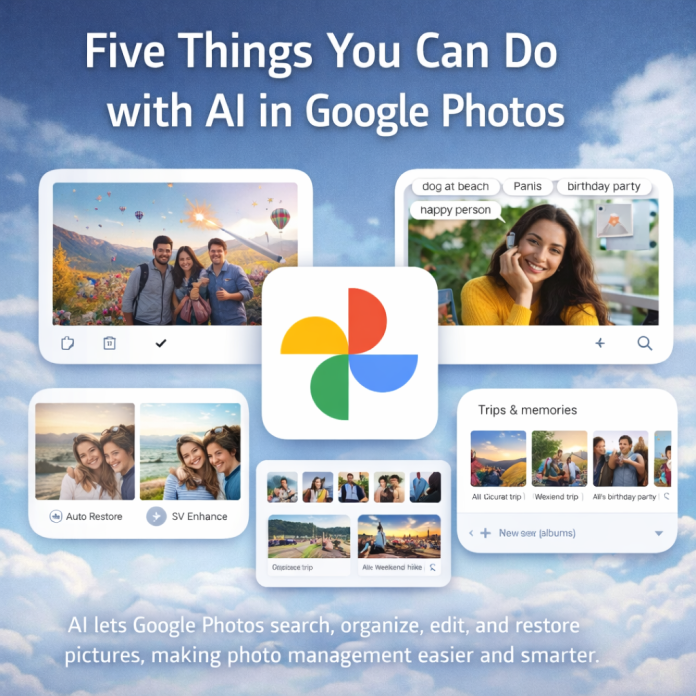
Artificial intelligence is quietly changing how people use Google Photos, turning it from a simple storage app into a powerful photo-management assistant. With built-in AI features, users can now do much more than just back up images.

One of the most useful capabilities is smart search. Google Photos can find pictures using natural language queries such as objects, locations, events, or even moods—without users needing to tag photos manually.

AI-powered photo editing tools make enhancements effortless. Users can remove unwanted objects, adjust lighting, sharpen images, and improve overall quality with just a few taps, even if they have no editing experience.

The app also helps with automatic organisation. Photos are grouped by people, places, and events, making it easy to browse memories or create albums without spending time sorting images manually.

Another powerful feature is memory creation. Google Photos automatically curates highlights from trips, celebrations, or specific dates, turning everyday photos into shareable stories.

Finally, AI assists in photo restoration and enhancement, helping improve older or low-quality images by reducing blur, enhancing colors, and restoring details.

Together, these AI-driven features make managing, editing, and rediscovering photos faster, simpler, and more intuitive for everyday users.


Author
Experienced in the entrepreneurial realm and skilled in managing a wide range of operations, I bring expertise in startup launches, sales, marketing, business growth, brand visibility enhancement, market development, and process streamlining.

Hot this week

Terraform Is Green, Systems Are Red: Drift in AIOps

Terraform may report success while production quietly drifts. Learn how to detect configuration, runtime, and behavioral drift using observability, policy engines, and AIOps-driven reconciliation.

Reference Architecture: End-to-End Incident AI Pipeline

A vendor-neutral blueprint of the full Incident AI pipeline—from alert ingestion to RCA, remediation, and postmortem learning—plus build-vs-buy guidance for enterprise teams.

Designing the AIOps Data Layer for Signal Fidelity

Most AIOps failures stem from weak data foundations. This deep-dive guide defines canonical pipelines, schema strategies, and quality controls to preserve signal fidelity.

Enhance AIOps Security with Advanced Threat Detection

Explore practical strategies to secure AIOps pipelines with advanced threat detection, enhancing data protection and integrity in evolving IT environments.

Pod-Level Resource Managers and AIOps Signal Integrity

Kubernetes 1.36’s pod-level resource managers reshape more than scheduling—they redefine observability signals. Here’s how memory QoS and pod-scoped controls impact AIOps baselines, forecasting, and automation.

Topics

Terraform Is Green, Systems Are Red: Drift in AIOps

Terraform may report success while production quietly drifts. Learn how to detect configuration, runtime, and behavioral drift using observability, policy engines, and AIOps-driven reconciliation.

Reference Architecture: End-to-End Incident AI Pipeline

A vendor-neutral blueprint of the full Incident AI pipeline—from alert ingestion to RCA, remediation, and postmortem learning—plus build-vs-buy guidance for enterprise teams.

Designing the AIOps Data Layer for Signal Fidelity

Most AIOps failures stem from weak data foundations. This deep-dive guide defines canonical pipelines, schema strategies, and quality controls to preserve signal fidelity.

Enhance AIOps Security with Advanced Threat Detection

Explore practical strategies to secure AIOps pipelines with advanced threat detection, enhancing data protection and integrity in evolving IT environments.

Pod-Level Resource Managers and AIOps Signal Integrity

Kubernetes 1.36’s pod-level resource managers reshape more than scheduling—they redefine observability signals. Here’s how memory QoS and pod-scoped controls impact AIOps baselines, forecasting, and automation.

Comparing FinOps Tools for Cost-Efficient AIOps Management

Explore and compare leading FinOps tools to optimize AIOps costs. Evaluate features, pricing, and real-world performance for informed financial decision-making.

AI-Driven Observability: Future Trends in IT Monitoring

Explore how AI-driven observability is transforming IT operations with predictive analytics, automated analysis, and enhanced security.

Mastering AIOps: Building a Hybrid Cloud Strategy

Explore how to implement a robust AIOps strategy in hybrid cloud environments. Learn best practices, common pitfalls, and architectural considerations.
spot_img

Related Articles

Popular Categories

spot_imgspot_img

Related Articles