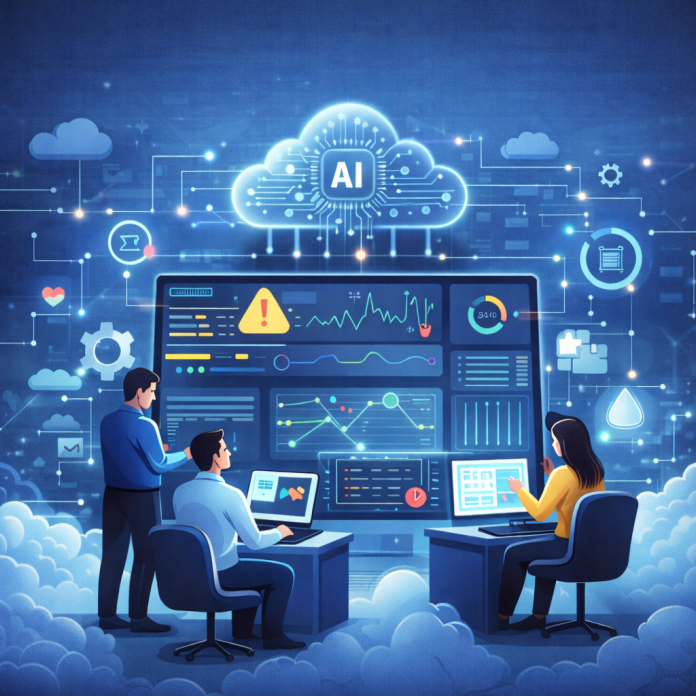

As organizations accelerate their move to the cloud, DevOps teams are facing an unprecedented level of complexity. Modern applications run across multiple clouds, containers, microservices, and distributed systems, generating massive volumes of logs, metrics, and events. Traditional monitoring tools struggle to keep up. This is where AIOps (Artificial Intelligence for IT Operations) is redefining how DevOps monitoring works in the cloud era.
The Limits of Traditional DevOps Monitoring
Conventional monitoring relies heavily on static thresholds, manual dashboards, and reactive alerts. While this approach worked for simpler, on-premise systems, it falls short in cloud-native environments where workloads scale dynamically and failures are often interconnected.
DevOps teams are overwhelmed with alert noise, slow root-cause analysis, and fragmented visibility across tools. As a result, mean time to detect (MTTD) and mean time to resolve (MTTR) incidents continue to rise, directly impacting user experience and business outcomes.
What AIOps Brings to the Table
AIOps applies machine learning and advanced analytics to operational data such as logs, metrics, traces, and events. Instead of treating monitoring as a passive activity, AIOps enables intelligent, proactive operations.
Key capabilities include:
-
Automated anomaly detection without predefined thresholds
-
Noise reduction by correlating related alerts into meaningful incidents
-
Root-cause analysis powered by pattern recognition
-
Predictive insights to identify issues before they impact production
This shift allows DevOps teams to move from firefighting to foresight.
Smarter Monitoring in Dynamic Cloud Environments
Cloud platforms are elastic by design. Resources spin up and down constantly, making static rules unreliable. AIOps learns normal behavior patterns over time and adapts as systems evolve. When something deviates from the baseline, it detects the anomaly in real time.
This adaptive monitoring is especially valuable for:
-
Microservices architectures
-
Kubernetes and container platforms
-
Multi-cloud and hybrid deployments
Instead of hundreds of alerts, teams get actionable insights.
Faster Incident Response and Reduced Downtime
One of the biggest advantages of AIOps is faster incident resolution. By correlating signals across the entire stack, AIOps pinpoints the most likely root cause, helping engineers act quickly and confidently.
In many environments, AIOps can even trigger automated remediation, such as restarting services, scaling resources, or rolling back faulty deployments. This dramatically reduces downtime and improves service reliability.
Enabling Proactive and Predictive Operations
AIOps doesn’t just react to incidents—it helps prevent them. By analyzing historical trends and behavioral patterns, AIOps can forecast capacity issues, performance degradation, or failure risks.
This predictive capability supports:
-
Better capacity planning
-
Smarter release management
-
Improved SLA and SLO compliance
DevOps teams gain the ability to fix problems before users notice them.
A Cultural Shift for DevOps Teams
Beyond technology, AIOps drives a cultural change. Teams spend less time manually sifting through data and more time on innovation, optimization, and strategic improvements. Monitoring becomes intelligence-driven rather than dashboard-driven.
AIOps also strengthens collaboration between development, operations, and business teams by translating technical signals into business-impact insights.
<a href="https://aiopscommunity1-g7ccdfagfmgqhma8.southeastasia-01.azurewebsites.net/self-optimizing-buildings-the-future-of-facility-automation/" title="Self-Optimizing Buildings: <a href="https://aiopscommunity.com/how-opentelemetry-is-shaping-the-future-of-aiops/" title="How OpenTelemetry is Shaping the Future of AIOps”>The Future of Facility Automation”>The Future of DevOps Monitoring
As cloud environments grow more complex, AIOps will become a foundational layer of DevOps monitoring. Organizations that adopt AIOps early gain better resilience, faster deployments, and improved customer experiences.
In the cloud era, observability alone is not enough. Intelligent operations powered by AIOps are the key to scalable, reliable, and future-ready DevOps.