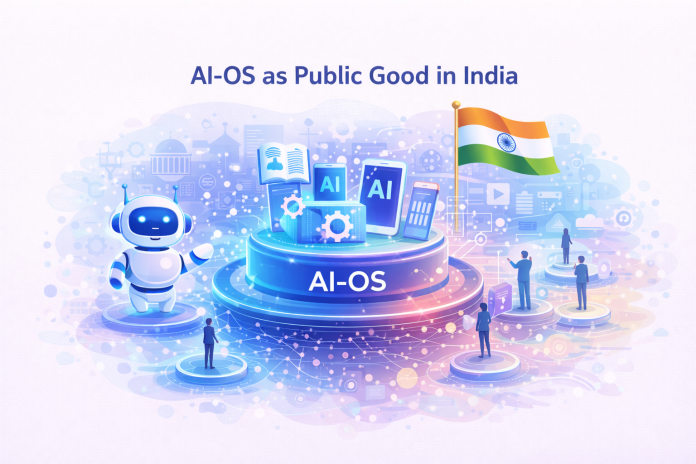

India’s latest Economic Survey has proposed the creation of an AI-OS (Artificial Intelligence Operating System) platform, positioning artificial intelligence as a public good that can be accessed, built upon, and scaled across sectors.
The proposal reflects a strategic shift in how India views AI—not merely as a commercial technology, but as foundational digital infrastructure, similar to digital identity, payments, and public data platforms.
AI as Digital Public Infrastructure
According to the Economic Survey, AI has the potential to deliver widespread societal and economic benefits if it is made accessible, interoperable, and affordable. The proposed AI-OS platform would function as a shared base layer, enabling startups, enterprises, researchers, and government agencies to develop AI applications without duplicating core infrastructure.
By treating AI as a public good, the model aims to reduce barriers to entry, encourage innovation, and prevent concentration of AI capabilities among a small number of large technology firms.
What Is the Proposed AI-OS Platform?
The AI-OS concept envisions a common AI framework that includes:
-
Shared AI models and foundational tools
-
Standardized data access and governance mechanisms
-
Common APIs for AI development and deployment
-
Built-in safeguards for privacy, security, and responsible use
-
Scalable compute access through public or hybrid infrastructure
This approach would allow developers and organizations to focus on use cases and outcomes, rather than rebuilding AI foundations from scratch.
Enabling Inclusive and Responsible AI Growth
One of the key objectives of the AI-OS proposal is to ensure that AI benefits are broadly distributed across the economy. The Survey highlights the importance of using AI to improve outcomes in areas such as:
-
Healthcare and diagnostics
-
Agriculture and food security
-
Education and skill development
-
Public service delivery
-
Small and medium enterprise productivity
By lowering costs and standardizing access, the AI-OS platform could help smaller organizations and startups compete on a more level playing field.
Balancing Innovation With Governance
The Economic Survey also emphasizes the need for strong governance frameworks alongside AI expansion. As AI adoption increases, concerns around data misuse, bias, transparency, and accountability become more pronounced.
The proposed AI-OS would embed governance and compliance mechanisms at the platform level, helping ensure that AI systems are trustworthy, explainable, and aligned with public interest.
Reducing Dependency on Proprietary AI Systems
Another motivation behind the AI-OS proposal is to reduce long-term dependence on proprietary and closed AI platforms. By investing in open and shared AI infrastructure, India can strengthen its technological sovereignty while still collaborating globally.
The Survey suggests that this approach would also help Indian developers build AI solutions that are locally relevant yet globally competitive.
AI as a Growth Multiplier for the Economy
From an economic perspective, the Survey views AI as a productivity multiplier rather than a job destroyer. When deployed responsibly, AI can augment human capabilities, improve efficiency, and enable new forms of economic activity.
The AI-OS platform is presented as a long-term investment that supports sustainable growth, innovation, and resilience across industries.
Looking Ahead
The proposal to build an AI-OS platform signals a bold vision for India’s AI future—one that prioritizes access, equity, and public value. If implemented effectively, it could place India among the leading nations shaping AI as shared digital infrastructure rather than a purely commercial asset.
The success of this initiative will depend on execution, public-private collaboration, and continued investment in talent, governance, and compute infrastructure.